
Delta County Court Records After Arrest
The court-record path starts after a person is arrested, booked, and identified through the jail system. The booking record can list an arresting agency, statute, charge description, warrant number, bond, and status. Those details are useful, but they are not the same as the court case. Once the prosecutor files a complaint, information, indictment, or other charging paper, the filed charge becomes part of the Delta County court record. From that point forward, the clerk and court sources are the better place to look for case numbers, docket settings, amended charges, dispositions, and orders.
Use custody records and court records together, but keep them separate. The Delta County jail inmate records page is the better source for the Hopkins-hosted roster and booking fields. The Delta County jail mugshots page covers booking photos and photo-request issues. Court records after a jail arrest focus on the filed case, the charge status, and the judge or court action that follows the arrest.
Delta County Court Record Sources
The main local source is the Delta County County/District Clerk court-records page. It links to the statewide court-record search and provides the local clerk contact point. The clerk office lists phone 903-395-9302, fax 903-395-4260, and the 200 W. Dallas Ave address in Cooper. Published clerk hours are Monday through Thursday from 8:00 AM to 5:00 PM and Friday from 8:00 AM to 3:00 PM. Those are clerk records hours, not jail visitation hours and not sheriff records hours.
Delta County also publishes local docket pages that can help when a portal result is incomplete or a recent setting has not been easy to locate. The 8th Judicial District Court docket page is relevant to felony and district-court settings. The criminal misdemeanor docket page lists misdemeanor docket resources, including arraignment, pretrial, review, and misdemeanor docket materials. The 62nd Judicial District Court docket page is another official local court docket source for Delta County.
The official Delta County clerk source appears in the captured court-records page below.
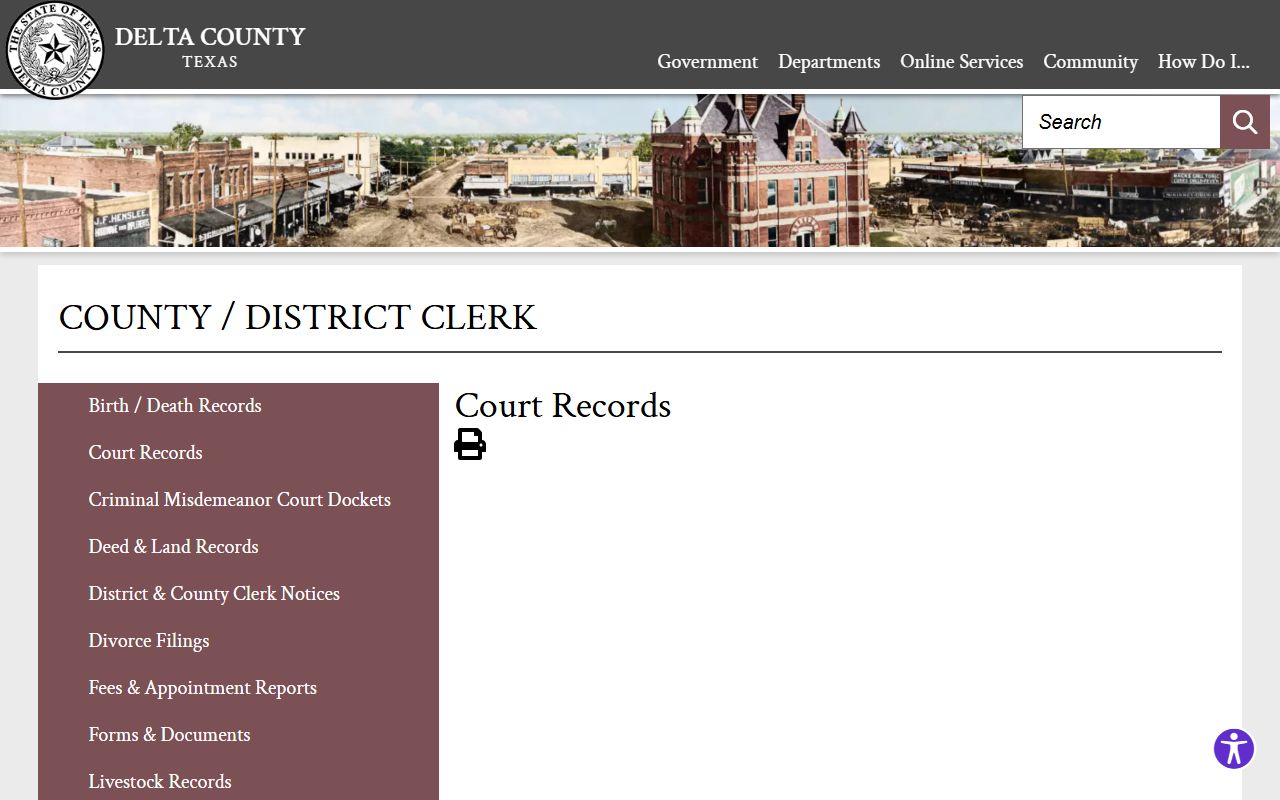
That source is the better starting point for filed case records. The sheriff can confirm a jail booking where releasable, but the clerk tracks the case once it exists in court.
Search Delta County Court Records After Arrest
Delta County links users to the Texas court-record search portal. Direct field inspection was limited in the research environment, so exact field labels should not be invented. The safe search method is to use the official portal from the clerk page, search by defendant name, add a case number when known, and compare results against local felony or misdemeanor docket pages. If the case is new, the online record may trail the arrest, especially if the prosecutor has not filed charges yet.
- Start with the defendant's full name from the jail roster or arrest paperwork.
- Open the clerk court-records page and use the linked statewide search portal.
- Search by name first, then add a case number, warrant number, or citation number if one is known.
- Check the 8th Judicial District, 62nd Judicial District, or misdemeanor docket page when the portal does not show a recent setting.
- Call or visit the County/District Clerk if the online record appears incomplete or the case may be older.
| Search Item | Verified Detail | Research Note |
|---|---|---|
| Defendant name | Use as the first search path | Exact portal field labels were not fully inspected because access was limited. |
| Case number | Use when known from docket, notice, or clerk communication | Can narrow common names and related cases. |
| Warrant or roster number | Compare with clerk results | Roster warrant fields may not equal a court case number. |
| Local docket PDFs | Use for recent settings | Delta publishes felony and misdemeanor docket resources separately. |
Delta County Prosecutor Role
The prosecutor is the bridge between a jail arrest and the filed court record. A deputy, trooper, or sheriff can book a person on an arrest charge, but the prosecutor decides what formal charge to file, whether to reduce or amend it, and whether to dismiss or add counts. Delta County's official County Attorney page lists Edgar J. Garrett as County Attorney with phone 903-395-4400 Ext. 9309, fax 903-395-2178, and a Cooper mailing address. County-level misdemeanor and local prosecution questions commonly pass through that office, depending on case type and court level.
Felony prosecution is tied to the 8th Judicial District. Delta County election records for the November 5, 2024 general election identify Will Ramsay as District Attorney for the 8th Judicial District. The research did not locate a separate detailed Delta-hosted district attorney office page, so filed felony case information should be checked through the court, clerk, and official docket sources rather than guessed from jail roster language. The roster charge is a lead. The prosecutor's filed charge is the court record.
Delta County Arrest Charging Records
After a Delta County jail arrest, the case can move through different charging documents. These terms are often mixed together, but they do different jobs. A complaint may appear early as a sworn allegation or lower-court charging document. An information is a prosecutor-filed charging paper, often used in misdemeanor practice and some waived-indictment settings. An indictment is a grand-jury charging document for many felony prosecutions unless the law allows a different route or the right is waived.
| Document | Who Creates It | Common Use | What It Means for Records |
|---|---|---|---|
| Complaint | Officer, complainant, or prosecutor process | Early allegation or lower-level prosecution step | May begin the public case path before later filing action. |
| Information | Prosecutor | Misdemeanors and some waived-indictment matters | Shows the charge the prosecutor chose to place before the court. |
| Indictment | Grand jury | Many felony cases | Can differ from the arrest charge first shown on the jail roster. |
Note: A booking charge is an accusation at intake, and it may not be the same wording or level later filed in court.
Delta County Charge Status
Court records after a jail arrest should be read by charge status, not just charge name. A record can start pending, then be amended, reduced, dismissed, deferred, or resolved by plea, trial, or other court order. Multiple counts can also move in different ways inside one case. The charge table below uses plain meanings because the exact wording depends on the court record, prosecutor action, and clerk notation.
| Status | Plain Meaning | Record Caution |
|---|---|---|
| Pending | The case or charge is still open. | No conviction should be inferred from a pending charge. |
| Amended | The charge wording, statute, or count has changed. | Compare the filed charge with the booking charge. |
| Reduced | The charge level or offense has been lowered. | Look for the final disposition, not only the first charge. |
| Dismissed | The charge was dropped by court action or prosecutor decision. | The arrest record may still exist unless expunged or otherwise restricted. |
| Deferred adjudication | A Texas case outcome where adjudication may be deferred under court terms. | DPS and court visibility can differ, and nondisclosure rules may apply later. |
| Convicted | The case ended in a guilty plea, verdict, or judgment of guilt. | Use court disposition and DPS history carefully because updates can lag. |
Delta County Bond Warrant Records
The jail roster may show total bond and charge-level bond amounts. That is operational jail information. Court records can show later bond conditions, bond reductions, bond forfeiture, failure-to-appear actions, or warrant settings. Delta County did not publish a detailed bond-posting guide or accepted payment list in the official sources reviewed. The safest route is to confirm custody and payment rules with the sheriff or holding jail before trying to post bond, especially when a Delta inmate may be physically held through Hopkins County Jail.
No official Delta County online active-warrant search was located. The sheriff page says the sheriff serves warrants and civil papers, but it does not publish a searchable warrant list. Warrant-related court history may appear in clerk records or docket settings, while warrant confirmation may require contacting the sheriff or the court that issued the warrant. A person who may have an active warrant should consider legal counsel before appearing at a law-enforcement office.
- Cash bond
- Money paid directly under court and jail rules to secure release and appearance.
- Surety bond
- A licensed bail bond company posts a surety for the defendant.
- PR bond
- Release on personal recognizance, based on a promise to appear and follow conditions.
- No-bond hold
- Custody status where payment of a listed amount will not resolve release.
Delta County Charge Conviction Records
An arrest charge is not a conviction. A Delta County court record after a jail arrest can show that a charge was filed, but the record must be read through the final disposition. Prosecutors may reject a booking charge, file a different offense, add counts, reduce a felony to a misdemeanor, or dismiss a case. A conviction requires a plea, verdict, or judgment. Treating the first roster charge as a final outcome is a common records mistake.
| Record Point | Charge | Conviction |
|---|---|---|
| Stage | Accusation or filed allegation | Final guilt finding or plea result |
| Source | Roster, complaint, information, indictment, or docket | Court judgment, disposition, and DPS history when reported |
| Meaning | The person is accused of an offense | The case produced a conviction outcome |
| Risk | Can change or be dismissed | Still may be appealed, sealed, nondisclosed, or expunged in limited cases |
Delta County Sealed Arrest Records
Texas uses more than one path for limiting public access to criminal records. Expunction under Code of Criminal Procedure Chapter 55A can destroy qualifying arrest records or treat them as not existing for many purposes. An order of nondisclosure under Government Code Chapter 411 can limit public disclosure while leaving some government and criminal justice access in place. Eligibility depends on the charge, disposition, waiting periods, and court order.
| Record Limit | Public Effect | Government Access | Delta County Search Impact |
|---|---|---|---|
| Sealed or nondisclosed | Public access is limited by court order. | Some agencies may retain access under Texas law. | Portal, clerk, and DPS display can differ by record type. |
| Expunged | Qualifying arrest records may be destroyed or treated as not existing. | Access is far more limited after the order is carried out. | Do not assume a missing record means no arrest unless official sources confirm it. |
Delta County DPS Record Limits
The Texas DPS Crime Records system is a statewide criminal-history source, not the Delta County court docket. DPS materials explain that Texas criminal history reporting covers Class B misdemeanor or greater arrest, prosecution, and disposition data submitted by criminal justice agencies under Chapter 66. The DPS Criminal History Conviction Name Search is a paid credit-based search for public conviction and deferred adjudication information. It can be useful for a statewide angle, but it is not a live local case lookup and it can lag if agencies have not reported a disposition.
Use DPS when the question is statewide criminal history. Use the clerk and court dockets when the question is a Delta County case setting, filed charge, dismissal, amended count, warrant, bond order, or final court disposition. Use the jail roster only for custody and booking facts.
Request Delta County Court Records
If an online search does not show the case, gather the name, arrest date, roster charge, warrant number, and any court notice or citation number. Then contact the County/District Clerk using the official clerk court-records page. For sheriff-created booking, arrest, offense, or incident records, use the Delta County Sheriff's Office open-records process instead. That page says written requests may be emailed to asuarez@deltacountysheriff.org or made in person at 200 West Dallas Avenue in Cooper, Monday through Friday from 8am to 5pm.
The sheriff open-records page says to allow up to 10 business days and to pay required fees before records are released. It also lists request identifiers such as report number, incident type, report date, incident address, parties involved, and other locating details. Court records after a jail arrest work best when the request is aimed at the right office: sheriff for booking and law-enforcement records, clerk for filed case records, prosecutor for prosecution-related communications when legally available, and DPS for statewide criminal-history records.